Sunday, December 7, 1997 (Travel section, Page G1, The State)
By Tim Brosnan, Staff Writer
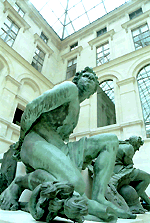 The Louvre is a vast repository of artwork that spans centuries of creative genius. We wondered if these bedraggled bronze figures representing countries defeated in battle might just as well represent the many, who like us, had tried to take in the whole museum in a day. |
Will you love Paris in the winter?
That depends.
If you enjoy big cities (on the order of 8 million), speak marginal French (can both ask and understand the answers to simple questions) and your cartographic skills are way above average, Paris might be the only place in France you need to go at any time of year.
But if you're like many - linguistically and logistically average - three or four days in the French capital might be the point where your sense of fascination, blunted by diesel fumes and urban cacophony, gives way to sensory overload.
Not to worry, though.
Paris can be "done" in three or four days — not thoroughly, of course, but well enough to make a lasting impression.
Afterward, several pounds heavier from a steady diet of cheese, bread, sauces and pastries, your camera still warm from constant use, you'll be ready to hop a train to someplace quieter.
And there are many such places in France from which to choose. Reduced-price hotel rooms are plentiful just now, which is why the last quarter of this or any year is our first choice for vacation travel.
Par avion
Buying airline tickets is like playing the stock market. Less than a week after locking into $450 round-trip from Charlotte, we saw an ad for round-trip tickets from New York to Paris for less than $300.
Surprisingly (or maybe not), our travel agent was able to get us lower fares than we could find on the Internet. He also gave us excellent travel advice and booked us into a great little hotel in the heart of Paris. These are the kinds of perks we believe make arranging travel through a reputable agent vastly preferable to the Internet.
One last word on international airline travel. The warning printed on your ticket that says you must arrive at the counter 30 minutes prior to departure is not a joke. Our return was delayed a day by our failure to take it seriously.
L'hotel
We divided our eight-day French vacation almost equally between Paris and Annecy, a small city in the south of France near the Swiss border. In Paris, we paid roughly $80 per night for a very comfortable room at the Hotel de la Paix. A double bed, private shower, small sofa and writing table made our third-floor room just across the street from a downtown metro stop a bargain by Parisian standards.
In Annecy, we paid about $50 for a similar room within walking distance of everything of interest.
The rates we paid in both cities were as little as half of those posted on the doors to our rooms which, we were told, were regular season rates.
The larger and more expensive the hotel, it seems, the more likely the desk clerks will speak English. If this is important to you, and if you plan to shoot for midpriced accommodations, you should ask ahead about language spoken, private bathrooms, nonsmoking rooms and the like.
In addition to being able to make dinner and show reservations for their guests, hotels in Paris also can accept payment directly for some events, giving you a voucher redeemable for tickets at the performance site.
The staff at the Hotel de la Paix was happy to serve as our on-site travel agency, calling ahead for us, giving us directions, annotating maps and so on.
Had they not spoken fluent English, it would have been difficult for us to take advantage of these valuable services.
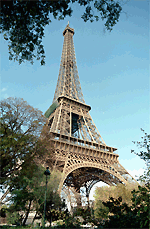 The Eiffel Tower — but then you knew that, didn't you? |
Le restaurant
Both our randomly chosen and reserved meals were, without exception, excellent.
Pastry shops, bistros, restaurants, bakeries and cheese shops seem to be everywhere. Even where we couldn't read the menu and the wait staff didn't speak English (and there were a few places like that), we could still throw a dart at the list of options provided and get something eminently enjoyable.
Bad news for weight watchers and nonsmokers, though.
The fabulous things French cooks do with food often involve liberal quantities of fat and French restaurantgoers love to smoke.
In Annecy, our dartboard method of ordering produced a pair of lightly grill-seared steaks sauteed at our table in what looked like a pound of herb butter.
This was served with fried potatoes intended to be dipped in the butter, and proceeded by bread served with yet more butter.
Our cholesterol-wary consciences died slow deaths as our mouths shot straight to heaven from this meal we topped off with - what the heck? -a dish of creme brulee (burnt cream).
Unusual, you say? Not really. Nor did we ever complain.
Second-hand smoke was another matter.
Ask for "pas fumer" (no smoking) and you'll be lucky if you increase the distance between your table and Monsieur Marlboro by more than an extra arm's length. As one Annecy resident smirkingly told us, a nonsmoking section in France is where nobody happens to be smoking at the moment.
You can improve your chances of enjoying a smoke-free meal, though, by arriving just as a restaurant opens. We found that French eateries don't get busy until around 8 p.m., so nonsmokers typically have about an hour to eat before the locals start lighting up.
Tipping generally isn't necessary in France. Most menus state clearly that a 15 percent gratuity has been included in the cost of the meal.
Prices vary greatly. Two people can eat breakfast for as little as $10, and then spend $100 (before alcohol) on dinner without batting an eye.
Le metro
Paris is a labrynthian maze where, map in one hand and written directions in the other, it's possible to get lost by walking two blocks in what appears to be a straight line. Do not wander. Take advantage of the excellent public transportation that puts all of Paris, its environs and the rest of the country within easy, understandable reach.
The metro (subway) includes stops at many of the major attractions around Paris and, when the landmark you seek isn't directly in front of the metro station you've just left, there's always a bus stop where a bus will soon arrive to whisk you along the last leg of your journey.
All forms of public transportation (bus, metro and RER or rapid transit) accept magnetically-striped tickets that can be bought singly or in groups of 10.
If you plan on staying in Paris for a week or more, you might want to look into some of the other payment plans available, but even at single-ticket rates, public transportation is well worth the price. It's possible to travel the entire breadth of Paris by metro for about a dollar. A ride on the RER from downtown to the airport or other suburban destinations is about $10.
When the time comes to leave Paris for other parts of France, the TGV is the way to go. We rode first class from Paris to Annecy, a scenic and comfortable three-hour journey, for about $80 per person. No-smoking cars are available.
Le what to do, au general
In Paris, pick up a copy of Figaroscope, a tabloid that lists all the concerts, exhibits, floor shows, festivals and other happenings in the city for the week ahead.
Use it to plan your evenings.
Then pick two or three sites to see each day and confer with the staff at your hotel about metro routes, reservations and so on. The staff should also be happy to recommend restaurants that would complement your itinerary.
If you plan ahead and pace yourself, you'll do well in Paris, but if you must explore, do so carefully and use metro stops as your beacons in the wilderness.
When traveling between cities, take the TGV and treat yourself to first-class tickets. They aren't that much more expensive than regular fare and you can almost imagine you're riding on the Orient Express.
Wherever you go in France, eat dinner early and eat often. Buy bread and cheese and carry it around with you for snacks. Nobody in their right mind goes to France to diet.
Learn a little French and it will take you far. If nothing else, learn how to say "Hello. Do you speak English?" and "Thank you." It's just good form. Everywhere we went, we made an effort to speak the language, and everywhere we went we were treated graciously. Coincidence? We think not.
Accept and act on the advice of people who've traveled in (preferably who've lived in) France and ask for suggestions once you're there. Our best restaurant experience occurred as the result of a recommendation made to us by a woman we met on a train. I'm sure we would have never found it otherwise.
Similarly, without the advice of our travel agent, we would have never found our hotel and without the staff at our hotel, we would have had a much harder time finding France.
Tim Brosnan is a general assignments reporter/photographer.

Boxed "highlights"
Asking somebody what to do in Paris, or France for that matter, is like asking them how you should invest your money. The answer depends on you. That said, here's a list of some highlights of our trip:
L'Orchestre de Paris: There's nothing quite like dinner at a quaint Paris cafe followed by a symphony concert. Tickets start around $10, but if that's too expensive, there are musicians playing for pennies underground in the metro.
Opera National de Paris: Is it world class? We don't know, but at $150 a ticket for orchestra seats, we figure it's in the ballpark.
The Louvre: At $10 per ticket, there probably isn't a better buy in the galaxy. Unfortunately the Louvre is almost a city unto itself, and more than anybody could comprehend in a single day. Whether you do it by the medium, the period or the artist, you'd do well to decide in advance what you want to see.
L'Affriole: This is a tiny side-street restaurant recommended to us. The chefs/owners make their own bread and get their vegetables from a family-owned garden outside the city. Expect to pay about $80 per couple for a meal you'll tell your children about. 17 Rue Malar. Telephone: 01 44 18 31 33.
The TGV: Yes, this is the train that takes you from Paris to points elsewhere, but it's a great way to see the French countryside as part of either a day trip or an overnight visit to another city. The compartments are immaculate and comfortable, the windows are large, and the ride is smooth as silk.
Annecy: This town was suggested by a woman who worked the desk at our hotel in Paris. Nestled beside a beautiful lake at the foot of snow-capped mountains, its historic district boasts cobblestone streets, medieval churches and a castle that doubles as an art museum.